
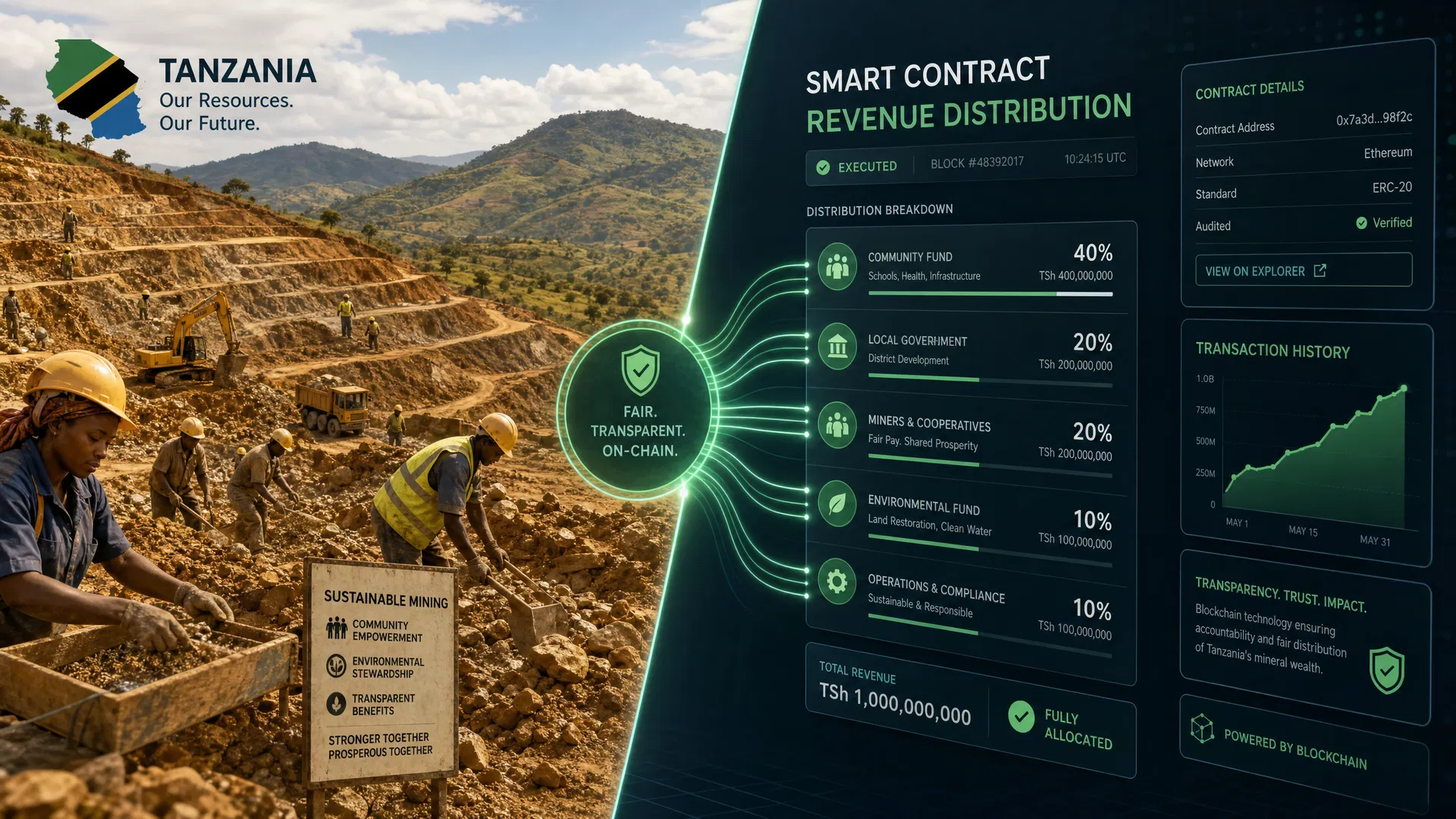
Tanzania’s mining sector is a cornerstone of its economy, contributing significantly to GDP, employment, and foreign exchange earnings. The country is endowed with vast mineral resources, including gold, diamonds, and tanzanite, which have attracted both local and international investors. However, the management and distribution of mining royalties have historically faced challenges related to transparency, inefficiency, and equitable sharing of revenues among stakeholders. As the Tanzanian government and mining companies strive for improved governance and sustainable development, smart contract technology offers a transformative solution to ensure fair, transparent, and timely distribution of mining royalties.
Mining royalties in Tanzania represent a critical revenue stream for both the government and local communities. According to the Tanzania Extractive Industries Transparency Initiative (TEITI), mining contributed approximately 4.5% to Tanzania’s GDP in 2022, with royalties accounting for a substantial portion of government revenues. Despite this, delays in royalty payments, disputes over revenue allocation, and leakages due to opaque processes have undermined trust and affected socio-economic development in mining regions. These issues are not unique to Tanzania but resonate across several African nations where resource wealth has not consistently translated into broad-based prosperity.
The advent of blockchain technology and, more specifically, smart contracts, presents a paradigm shift in how mining royalties can be managed. Smart contracts are self-executing contracts with the terms of agreement directly written into code, running on decentralized blockchain platforms. This technology eliminates intermediaries, enhances transparency, and automates payment processes, ensuring that royalty distributions occur according to predefined rules without delay or manipulation. For Tanzania, integrating smart contracts into royalty management can revolutionize the entire revenue flow from extraction to final distribution.
One of the principal advantages of smart contracts in the context of mining royalties is the ability to create immutable and auditable transaction records. Each royalty payment and distribution event can be recorded on a blockchain ledger accessible to all stakeholders, including government agencies, mining companies, local communities, and civil society organizations. This transparency mitigates corruption risks and builds confidence in the process. For example, in Ghana, the use of blockchain pilots in the extractive sector has demonstrated improved accountability and reduced leakage in royalty payments, setting an encouraging precedent for Tanzania and the wider East African region.
Tokenization, a process closely linked to smart contracts, further amplifies the benefits by converting real-world royalty rights into digital tokens on a blockchain. These tokens can represent fractional ownership or entitlement to future royalty revenues, enabling more inclusive participation by local communities and investors. Such financial inclusion tools empower stakeholders who traditionally have limited access to mining revenues. In South Africa, pilot programs using tokenized assets in mining have shown promise in democratizing access to mining benefits and creating secondary markets for royalty rights, which can unlock liquidity and financing opportunities.
The Tanzanian government’s ongoing reforms in the mining sector, including the Mining Act amendments and efforts to improve local content policies, align well with the deployment of digital infrastructure like blockchain. Smart contracts can be embedded within regulatory frameworks to enforce compliance automatically, ensuring mining companies remit royalties promptly and in full. Furthermore, these contracts can be programmed to allocate a portion of royalties directly to community development funds, social projects, or environmental rehabilitation initiatives, fostering sustainable mining practices aligned with Tanzania’s Vision 2025 development goals.
Implementing smart contracts for mining royalties does require addressing several challenges. Digital infrastructure gaps, stakeholder education, and regulatory clarity are essential prerequisites. Tanzania’s increasing mobile penetration—currently above 85%—and growing internet connectivity provide a solid foundation for blockchain adoption. Additionally, partnerships with regional blockchain initiatives such as the African Blockchain Alliance and support from international organizations like the World Bank can accelerate capacity building and pilot programs. AfriVest’s platform, with its focus on asset tokenization and cooperative governance, is uniquely positioned to facilitate this transition by providing the necessary technological and governance frameworks tailored to African contexts.
Looking ahead, the integration of smart contracts into Tanzania’s mining royalty ecosystem represents more than just a technological upgrade; it symbolizes a move towards equitable, transparent, and inclusive resource governance. AfriVest envisions a future where digital infrastructure underpins Africa’s natural resource management, unlocking value for all stakeholders while minimizing disputes and inefficiencies. By harnessing blockchain and tokenization, Tanzania can set a benchmark in Africa for responsible mining revenue management, supporting socio-economic development and increasing investor confidence.
AfriVest remains committed to partnering with governments, mining companies, local communities, and development institutions to co-create solutions that leverage smart contracts and digital asset tokenization. Our platform’s cooperative governance model ensures that all voices are heard and that revenue flows are fair and traceable. As Africa’s digital infrastructure platform, AfriVest is at the forefront of driving the continent’s economic digitization, empowering countries like Tanzania to harness innovation for sustainable growth and financial inclusion. The future of mining royalties in Tanzania is poised for transformation, and AfriVest is proud to be a catalyst in this journey toward a more transparent and equitable digital economy.